Chiral oxazolidinones via biocatalytic aziridination of unactivated alkenes
Abstract
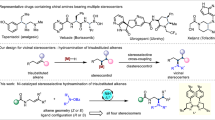
Chiral oxazolidinones are privileged heterocycles broadly used in asymmetric synthesis (1) and drug discovery (2–3). Conventional synthetic routes rely on a “chiral pool” strategy, where enantiopure amino alcohols are required as key intermediates. Of particular importance are a class of 5-(S)-aminomethyl oxazolidinones that are key scaffolds in next-generation antibiotics targeting multidrug- and extensively drug-resistant Mycobacterium tuberculosis (4–6). While many strategies exist to construct chirality at the 4-position (α-to-nitrogen), methods to install the desired 5-stereocentre (α-to-oxygen) remain underdeveloped. Here we report a haemprotein-catalysed aziridination/ring-expansion cascade that enables direct, enantioselective synthesis of clinically relevant and discovery-stage oxazolidinones from simple alkenes. This work advances haemprotein-catalysed nitrene transfer by enabling functionalisation of unactivated alkenes, a reactivity previously limited to conjugated systems such as styrenes. Computational analysis further reveals that key mutations introduced through directed evolution are responsible for the enantioselective formation of these products.
This is a preview of subscription content, access via your institution
Access options
Access through your institutionAccess Nature and 54 other Nature Portfolio journals
Get Nature+, our best-value online-access subscription
$32.99 / 30 days
cancel any time
Learn moreSubscribe to this journal
Receive 52 print issues and online access
$199.00 per year
only $3.83 per issue
Learn moreRent or buy this article
Prices vary by article type
from$1.95
to$39.95
Learn morePrices may be subject to local taxes which are calculated during checkout