Hepatocytes promote liver metastasis of pancreatic cancer by providing serine
Abstract
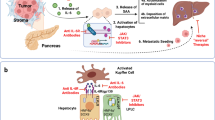
The liver is the primary site of metastasis in pancreatic ductal adenocarcinoma (PDAC), and liver metastases are a major cause of mortality1,2. Nutrient availability in the metastatic niche influences colonization efficiency; however, the metabolic heterogeneity of disseminated tumour cells can also reshape the local microenvironment3,4,5. Loss of phosphoglycerate dehydrogenase (PHGDH), the rate-limiting enzyme in de novo serine biosynthesis, is observed in nearly 40% of PDACs, and renders these cells dependent on exogenous serine (exSer)6. Although a neuron–tumour metabolic cross-talk supports exSer-dependent PDAC cells at the primary site6, it remains unclear how these cells adapt to the metastatic liver niche. Here we show that exSer-dependent PDAC cells reprogram neighbouring hepatocytes through a CXCL5–CXCR2 axis. Activation of CXCR2 in hepatocytes promotes PI3K–AKT signalling, leading to the sequestration of FOXO3A in the cytoplasm and derepression of PHGDH transcription, thereby enhancing serine production in hepatocytes. This hepatocyte-derived serine supports the outgrowth of exSer-dependent PDAC liver metastases. Accordingly, genetic or pharmacological inhibition of individual nodes within the CXCL5–CXCR2–PI3K–AKT–FOXO3A axis, or hepatocyte-specific deletion of Phgdh or Cxcr2, markedly reduces the liver-metastasis burden in mice and prolongs survival, particularly when dietary serine is restricted. Our findings reveal a cancer cell–hepatocyte metabolic cross-talk and identify therapeutic targets for exSer-dependent PDAC liver metastases.